
Having received the phone call, I knew that it was once again, that time. Once more into the breach, forced to “suffer” another trip (albeit a short four-day excursion) to a country which features an environment of fascinating, exotic beauty, is steeped in history, and is home to a kind, generous, happy population of generally moderate Muslims who, despite the following of their faith, have an acceptance of the beliefs of others. For them, there are no infidels. Only alternatives. How refreshing and at the same time, promising, for other regions.
Just as “insufferable” would be my guide for this trip – my good friend Moncef Battikh. If ever there was an ideal People’s Ambassador for Tunisia, it is the irrepressible Moncef. With enough suavity and charm to match our very own Mr Bond, he really does act on behalf of His Majesty’s Tourism Service when he represents the kingdom.
Tuesday
We began our journey from our respective homes, meeting at Heathrow Terminal 2. (Dependant on which day you wish to depart, flights are available from either Heathrow or Gatwick). We were joined there by fellow journalist, the lively and extremely chatty Georgia Lewis. This little Aussie could talk for Australia, and as I apparently, “have got more rabbit than Sainsbury’s”, I suppose it was inevitable that we got on famously!
Once at Tunis airport, the process of clearing Customs and Passport Control was, as on previous occasions, fairly simple and we were soon on the way to our base – the Regency Hotel. Having stayed here before, I was eagerly looking forward to a meal at the in-house White Elephant Thai restaurant at some point. However, tonight it was the regular buffet-style restaurant which, as on previous occasions, did not disappoint. The food selection is always varied and takes into account all kinds of culinary desires. For instance, I designed my own salad meze by placing seven different salads on a plate, from a selection of around 15. The main courses were again, abundant and varied, so I felt compelled to create another taster dish of my own, such was the selection of fish, chicken and meat, not to mention the variety of vegetables. The options with regards to desserts and fruit were again, plentiful and indeed, mouth-wateringly tempting. After this feast, it was off to our rooms for some relaxing and preparation for the next day.
Wednesday
Once a hearty breakfast had been consumed, we set off for the Acropolium, originally a Roman Catholic church built in 1884 by the French Protectorate in honour of Louis XIV. Although the building is no longer operating as a church, the original and wonderful interior artwork has been retained and it is still open to the public for visits. The finely decorated and gilded main area where mass would once have been held, now serves as an area for concerts and events. (We happened to run into Aida Niati, an artiste due to perform here in a few days but sadly, her performance would be after our departure). Immediately outside the Acropolium, ruins can be seen, with the coastline visible beyond, although some distance away.
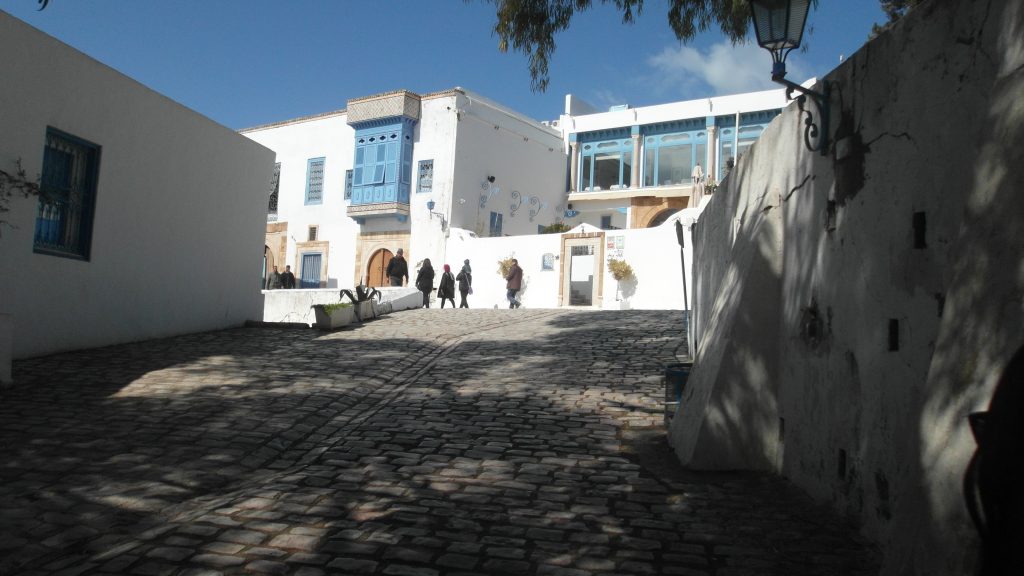
We ventured onwards to a place which I truly love here in Tunis, the area known as Sidi Bou Said. If a picture is worth a thousand words, then I must have a lot to say about this particular place, as I would estimate that I have taken around a thousand pictures of this hillside area, over the five trips I have made here. This is the Tunisian answer to the Greek island of Santorini – brilliant white buildings, with doors, frames, window shutters and other features painted in blue. A truly wonderous sight, especially as you gaze down over Sidi from a high vantage point, towards the shimmering, ripple-less Mediterranean. During our walk around here, we visited Dar El Annabi. Many homes throughout Tunisia have been transformed into hotels, restaurants or other business premises, and as an indication of their previous use as a home, they utilise the prefix “Dar” (meaning “home”) before the name. However, in this instance, Dar El Annabi has been preserved as an example of a typical, traditional Tunisian home, deliberately left intact, as a museum and reminder of what these Dar establishments looked like as dwellings, before their change for commercial use. One can mill around Dar El Annabi looking at the house and its old contents, buy mint tea and pastries and enjoy them in the marvellous garden, before venturing onto the rooftop for a spectacular view of the area.
We also came across Art Dar, a recent conversion to a gallery (completed August 2018), where the owner displays and sells jewellery, pieces of art, and one-off items of artistically designed/decorated clothing. In general, Sidi Bou Said is ideal for shopping, having a meal, or simply enjoying coffee as you gaze out, over the harbour.
Lunch was taken at the nearby Pirate restaurant. The obligatory harissa dip was served, which you scoop up with the accompanying strips of celery, carrot, or other similar vegetable. A salad topped with grilled pieces of chicken was also on offer, to keep us busy until the main course was served. However, an additional course was served whilst we waited – a wonderful brick. This is a filled, quick-fried crunchy filo-style pastry, this particular one containing a whole egg with prawns. It may sound like a strange combination, but I do recommend you try it. Tunisians do know a thing or two about blending flavours. My main course (sea bass), was cooked to absolute perfection, although I am still awaiting news of a hitherto undiscovered species of fish – one with no bones!!!
In the afternoon we attended the M.I.T. travel fair, promoting Tunisia as a travel destination. The event was held at Le Kram Parc des Expositions and was launched with a traditional Tunisian opening ceremony, after which we met several dignitaries, including Rene Trabelsi, the Minister of Tourism & Handicrafts. During a short interview with Georgia, he commented that:
1. The return of peace and security in Tunisia was of the utmost importance, in order to rebuild the excellent tourism trade which, although had been flourishing, was greatly diminished following two deadly terrorist attacks in 2015. Tunisia responded to this on-going worldwide threat, ensuring a constant presence of the security forces throughout the country.
* As a result of this pro-active measure, I do feel there would be a more immediate response to any threat in Tunisia, than in the UK. Here, we would hope that the police response time to any threat would be sufficient to minimise fatalities or damage. In Tunisia however, response time is immediate, simply because armed security forces members are already present on the streets and also outside hotels and museums, on beaches and at other public sites.
2. Following those tragic events, with tourism numbers from the UK falling drastically due to a “no-fly” policy, the Tunisian Ministry concentrated on promoting tourism based around other activities, rather than the usual beach related activities, in order to attract an additional clientele. These activities included Ecological Tourism, Mixed Sports Events, and Sahara Adventures (which included extreme motorcycle and car events). These now run alongside the usual hotel/beach holidays.
3. There has also been a growth in boutique hotels in Tunisia. This alternative to the recognised big hotels does indeed appeal to many and the desire by travellers to stay in this type of alternative accommodation has encouraged their growth. Additionally, as homes throughout the country have been converted for this purpose, it has also meant that locations where accommodation is available have become more widespread, enabling holiday makers to stay in less populated areas, should they wish for a quieter break.
4. Hotels now have airport-style security to minimise the threat of a terrorist attack.
5. Tourism figures for Tunisia are indeed rising, as the country has swiftly shown that it has acted positively with regards its security, in an attempt to prevent a repeat of the terrible events of 2015. As a result of these actions, tourism figures for the last few years have recovered, as shown below:
8.3 million (2018)
9 million (target for 2019 and on course at present)
10 million (target for 2020)
There is a good chance that, with various airlines due to drop their “no-fly” policy, and other airlines looking to open up a new route to Tunisia, the target of 10 million for 2019 may be exceeded.
The evening saw us return to the Regency hotel, where we had dinner at the White Elephant Thai restaurant. I thoroughly recommend a visit, even if you are not staying at this hotel. The female chef has been here for several years, and her cooking is wonderful and authentic. When she graciously attended our table so we could offer our thanks, she did mention that (understandably) obtaining ingredients here is far more difficult than in Europe. However, I will testify that despite this difficulty, the standard of the food is never compromised.
Thursday
Whilst Georgia visited the Bardo Museum (I had seen it on a previous visit) I was taken by Moncef to take in the Marche Central de Tunis – the local version of a Spitalfield’s – style market . What an absolutely colourful place! One huge hall was all about fish, with stallholders selling sardines, mackerel and sea bass, along with a host of other fish I was unable to recognise. Other stalls featured delights such as octopus and calamari (there were more on display than I thought existed in the sea!), snail like creatures, various types of eel, and of course, more fish. As we passed through an arch we found ourselves in an adjoining hall, specialising in fruit and vegetables. I must say, I have never seen such resplendent displays of food produce. Absolutely eye-catching! We turned a corner, passed through another arch, and the choice of cheeses, meats, olives, herbs and spices was a form of visual entertainment in itself. The smells had me salivating. When’s lunch?
In the late morning, Moncef and I met up with Georgia and we stopped by the famous El Jem Colosseum, which was used in the movie Gladiator. It is now utilised extensively in the summer, for live music events.
From here it was straight on to the Carthage Ruins. Again, I had visited this site on every occasion I had been to Tunis, but I couldn’t resist another walk around it, this time actually going down into the ruins. A truly magical site, from which you can also see the Gulf of Tunis.
As lunch time approached, we were whisked off to the area known as the Medina, a Unesco Heritage site, and also where the restaurant Dar Bel Hadj can be found. Owner Zohair greeted us, and in a typically Tunisian setting, we were served a meze style starter – a variety of small dishes, enabling us to try different foods. My main course was a lamb with vegetables, whilst Moncef had the Tunisian equivalent of Haggis.
We walked off the meal by perusing the Souk, the market place located in the labyrinth of small streets at the Medina. Full of traders and with as much vibrancy as you can imagine. Various items such as leather goods, perfumes, food, clothing, general bric-a-brac and souvenirs are all available and the sellers expect you to barter.
The evening saw us relaxing in the hotel, enjoying a drink and a meal before the following day’s trip to the airport. I must admit, I am always sad to leave this country.
I’ll say it again for a fifth time. Whether you want history, guaranteed sunshine, friendly people, a different culinary experience, historical art, unusual architecture, pampering, dune adventures, or just a beach-holiday experience, Tunisia has it all. I will also underline the fact that it is safe – for me, safer than most countries, simply due to the action taken by the authorities to tighten security.
Note: Despite my four previous visits to Tunisia, it was on this trip that I spotted for the first time, tracks in the road and realised that Tunis has a tram service – how did I miss that? Next time I will take a ride and compare it to transport services elsewhere. Additionally, I have yet to sample the delights of the Hammam experience. Perhaps next time I am in Tunis, I will tick two items from my “to-do” list. I will visit the nearest Hammam establishment so I can be pulled, pummelled and stretched like some out of shape rug, but will also ensure I take the tram to get there.
Questions:
If you are thinking of going to Tunisia and have any questions or concerns, feel free to email me at AndrosJournalist@aol.com and I will try my best to answer.